

BlogBlogs
How the DPDP Act Is Reshaping India’s Data Centre and Cloud Compliance Landscape

In the digital age, data is more than just information — it is the backbone of business innovation, customer engagement, and secure digital transformation. With increasing reliance on cloud computing, AI, and hyperscale data operations, enterprises must re-evaluate not only their technology stacks but also their compliance strategies. The Digital Personal Data Protection (DPDP) Act, 2023 is the cornerstone of this transformation in India, fundamentally reshaping how organizations approach data management, privacy, and infrastructure compliance.
For companies like Larsen & Toubro‑Vyoma, the DPDP Act is not merely a regulatory text — it has become a strategic impetus in building secure, sovereign, and compliant cloud and data centre environments that meet emerging enterprise and government requirements.
Understanding the DPDP Act: India’s New Data Protection Framework
The Digital Personal Data Protection (DPDP) Act, 2023 is India’s first dedicated legislation that governs the collection, processing, storage, and security of personal data. Passed by Parliament and supported by detailed rules like the DPDP Rules 2025, it introduces a consent-first model that places individual privacy at the heart of digital operations.
Unlike the older, fragmented framework under the IT Act, the DPDP Act creates clearly defined responsibilities for data fiduciaries (entities that determine how and why personal data is processed) and data principals (individuals whose data is processed). It also establishes a Data Protection Board of India with enforcement and adjudication powers.
Why DPDP Matters for Data Centres and Cloud Services
Cloud and data centre platforms — especially ones that host sensitive personal or enterprise data — are at the frontlines of DPDP compliance. The DPDP Act’s consent, minimisation, and security‑first stipulations make it mandatory for digital infrastructure providers to implement robust privacy practices.
For organisations such as Larsen & Toubro‑Vyoma, which delivers hyperscale data centre solutions, sovereign cloud platforms, and managed services, DPDP compliance must be part of the core infrastructure and governance architecture.
Key Compliance Imperatives under DPDP
Consent Management & Data Governance
Under the DPDP Act, personal data collection and processing are only lawful when explicit user consent is obtained and verifiable. This means cloud and infrastructure providers must support streamlined consent systems and audit trails that regulators can review.
Data Minimisation and Purpose Limitation
Cloud and data centre providers hosting workloads must ensure that only necessary personal data is processed, and only for defined purposes aligned with consent. Systems that automate data lifecycle policies — from collection to deletion — are essential.
Data Security and Breach Reporting
The DPDP Act mandates strong technical and organizational security safeguards, and timely reporting in the event of a breach. For hyperscale and sovereign cloud platforms like those provided by Larsen & Toubro‑Vyoma, embedding real‑time threat detection, identity management, and audit controls is crucial.
How Larsen & Toubro‑Vyoma is Enabling DPDP‑Ready Cloud & Data Centre Compliance
Larsen & Toubro‑Vyoma has emerged as a leader in building infrastructure that blends performance with security, sovereignty, and compliance. Its core offerings ensure that enterprises can meet both regulatory and operational challenges in a DPDP landscape.
Sovereign Cloud Platforms
In early 2026, Larsen & Toubro‑Vyoma launched its Sovereign Cloud Platform (SCP) — a cloud infrastructure purpose‑built for India’s regulatory environment. SCP ensures all workloads and data remain within Indian jurisdiction, reducing risks of foreign legal exposure and ensuring data governance complies with domestic laws like the DPDP Act.
The SCP supports:
- Air‑gapped deployment for sensitive government or critical infrastructure workloads.
- Compliance‑centric identity and access governance.
- Encryption and audit controls that align with advanced privacy frameworks.
This design helps enterprises accelerate AI‑driven workloads while maintaining compliance with privacy and sovereignty requirements.
AI‑Ready Data Centre & Managed Services
From hyperscale data centres to GPU‑as‑a‑Service and managed network and security services, Larsen & Toubro‑Vyoma provides an ecosystem that makes DPDP readiness operational rather than a compliance afterthought.
Their managed services include:
- Continuous threat monitoring
- Security incident response
- Backup as a Service (BaaS) with secure, encrypted data retention
- Infrastructure assessment for compliance gaps
A Strategic Advantage: DPDP Compliance as a Business Enabler
Complying with the DPDP Act is not just about avoiding penalties; it is about gaining competitive advantage. Organisations that can demonstrate trust, privacy safeguards, and sovereign data governance are more likely to build customer confidence — especially in sectors like finance, healthcare, and public services where personal data processing is high.
By providing secure infrastructure with embedded compliance — especially through Sovereign Cloud and managed services — Larsen & Toubro‑Vyoma enables customers to innovate without compromising on legal obligations.
Future‑Ready Data Compliance: Insights & Projections
The DPDP framework is still evolving, and enterprises are actively learning how to operationalise compliance in real infrastructure. Many privacy experts and regulators note that businesses must accelerate investments in data governance technologies to be ready before the full enforcement deadline of May 2027.
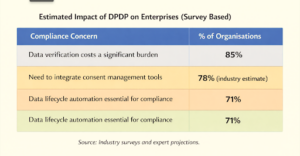
Below is a simple statistical snapshot of compliance impact:
📌 Estimated Impact of DPDP on Enterprises (Survey Based)
Conclusion
The Digital Personal Data Protection (DPDP) Act is a transformative milestone for India’s data governance ecosystem. It pushes enterprises and cloud‑infrastructure providers to embrace privacy, transparency, and sovereignty as foundational principles, not add‑ons.
For forward‑thinking organisations, partnering with a provider like Larsen & Toubro‑Vyoma ensures that compliance becomes a competitive differentiator — not just a regulatory checkbox. Whether through sovereign cloud deployment, managed security services, or AI‑ready data infrastructure, this marriage of scale and compliance is shaping the future of data centres in India.
